que cherchez-vous?

Dans un silencieux à absorption, le noyau perforé ne constitue qu'une partie du système acoustique. Le matériau qui l'entoure influe directement sur le bruit d'échappement, la qualité sonore, la stabilité thermique, la durée de vie de la laine de roche et l'état du silencieux à long terme.
Ce matériau est généralement connu sous le nom degarniture de silencieux.
Selon la conception du système d'échappement et le marché, le même composant peut également être décrit commematériau d'emballage du silencieux,garniture du silencieux d'échappement, garniture de silencieux, matériau d'amortissement d'échappement, rembourrage acoustique, laine de silencieux ou matériau d'amortissement d'échappement.
BSTFLEX fournit et développe des matériaux d'emballage haute température pour les silencieux de motos, les systèmes d'échappement automobiles, les silencieux de course, les silencieux industriels, les générateurs et autres ensembles d'échappement.
Explorez la gamme complète dematériaux d'emballage pour silencieux.
Un silencieux à absorption typique est construit autour d'une configuration relativement simple :
Flux des gaz d'échappement → tube perforé → couche de fibres protectrices → garniture acoustique → enveloppe extérieure
Les gaz d'échappement traversent le noyau perforé. L'énergie acoustique se propage à travers les perforations et pénètre dans le matériau fibreux environnant.
Au lieu de s'appuyer uniquement sur des chambres ou des chicanes restrictives, le garnissage convertit une partie de cette énergie acoustique en très petites quantités de chaleur grâce à la friction au sein de la structure fibreuse.
Pour que le système continue de fonctionner, l'emballage doit rester :
thermiquement stable,
suffisamment résilient,
résistant à l'érosion par impulsion d'échappement,
correctement emballé autour du noyau,
et capable de conserver sa structure fibreuse après des cycles répétés de chauffage et de refroidissement.
C’est pourquoi le choix d’un matériau d’isolation pour un silencieux d’échappement basé uniquement sur sa résistance à la température est rarement suffisant.
Le garnissage du silencieux remplit plusieurs fonctions simultanément.
La structure en fibres ouvertes absorbe l'énergie sonore générée par les pulsations d'échappement. Ceci est particulièrement important dans les silencieux à flux direct et les silencieux haute performance où le flux de gaz traverse un tube central perforé.
Les conditions d'emballage peuvent influencer non seulement la pression acoustique, mais aussi la tonalité de l'échappement.
Un garnissage neuf produit généralement un son d'échappement plus maîtrisé et moins métallique. À mesure que les fibres se détériorent, se compriment, migrent ou disparaissent, le silencieux peut devenir sensiblement plus bruyant et plus strident.
La couche de garniture crée une séparation entre le tube perforé chaud et le boîtier du silencieux.
Bien que le garnissage du silencieux soit principalement un matériau acoustique, ses caractéristiques thermiques influent sur la température du boîtier et la durabilité des composants adjacents.
Un garnissage stable réduit les contraintes acoustiques et thermiques directes sur l'enveloppe extérieure. Un système de garnissage bien conçu peut également limiter la détérioration interne du silencieux liée aux vibrations.
Il n'existe pas de matériau d'isolation pour silencieux idéal pour tous les systèmes d'échappement.
La température, la vitesse des gaz, le type de moteur, l'intervalle d'entretien prévu, le niveau sonore cible, la géométrie du silencieux et la méthode de fabrication influencent tous le choix des matériaux.
La fibre de verre demeure l'un des matériaux les plus utilisés dans les silencieux à absorption.
Elle combine une faible densité apparente avec une grande surface de fibres, ce qui lui confère une bonne absorption acoustique sans ajouter de poids excessif.
Les formes typiques comprennent :
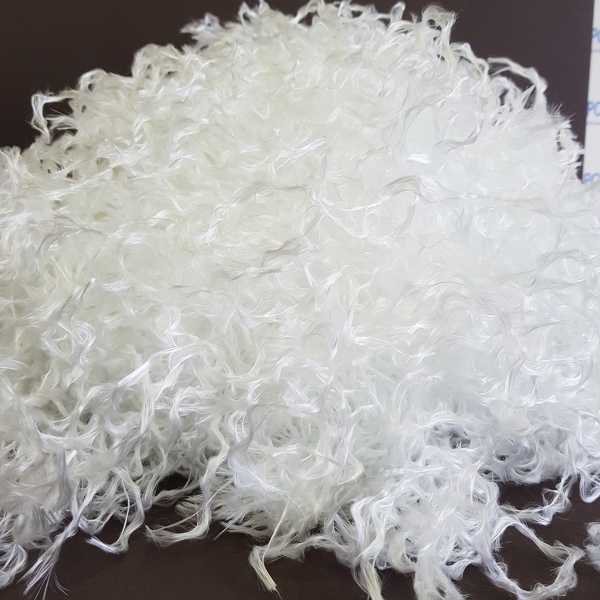
fil de fibre de verre en vrac,
fibre de verre à filament continu,
fibre de verre texturée,
nattes en fibre de verre,
coussins d'emballage en fibre de verre,
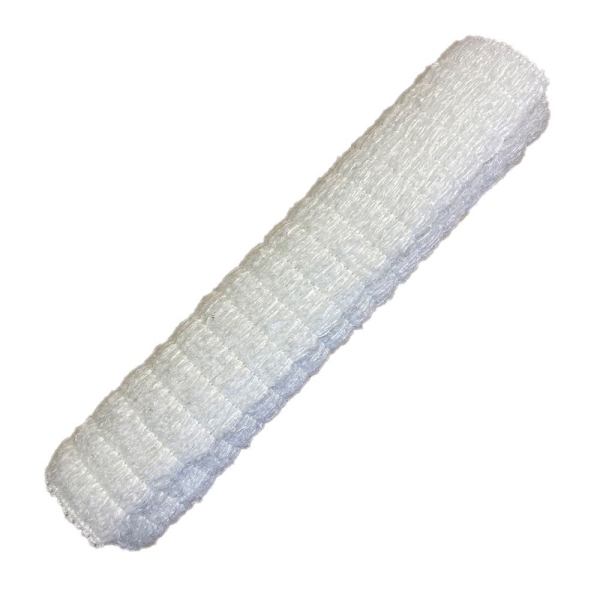
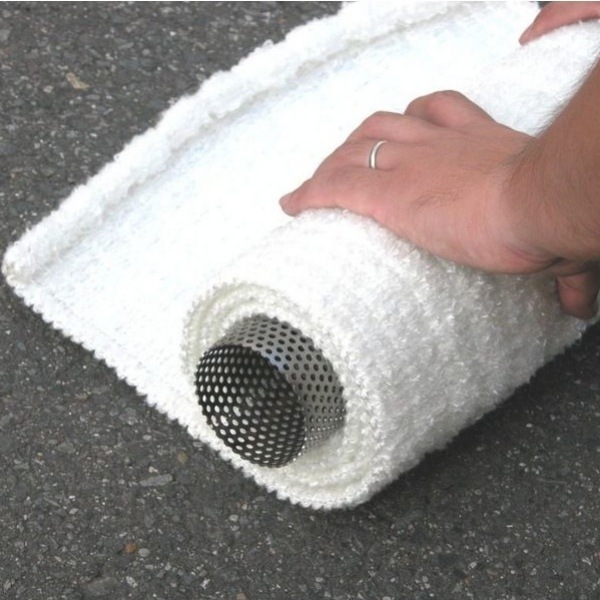
chaussettes d'emballage préformées,
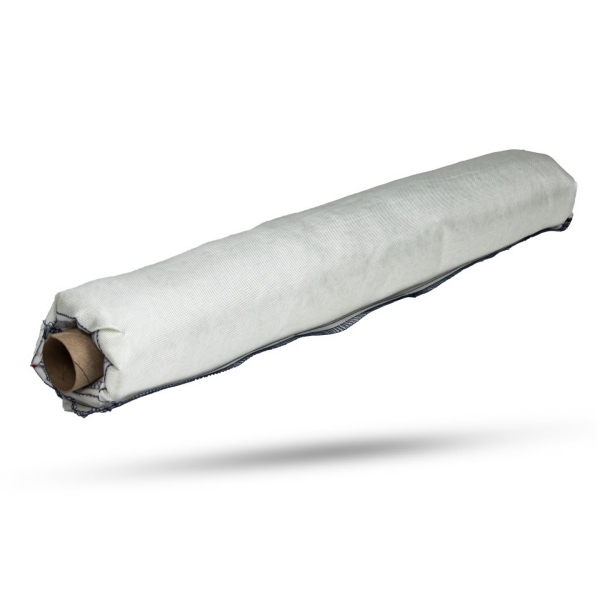
et de la fibre de verre contenue dans des sacs en maille de verre tissée.
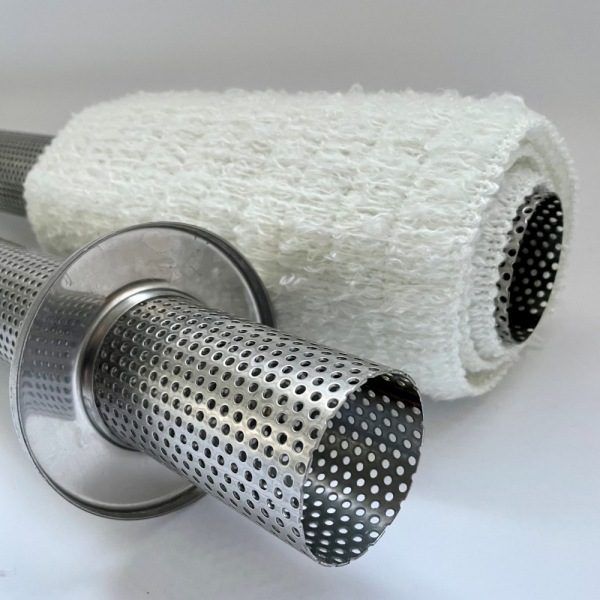
BSTFLEX fabrique unHousse de protection pour silencieux en fibre de verre avec sac en maille de verre tisséepour les applications où une installation contrôlée et une rétention des fibres sont préférables à un emballage lâche.
Le garnissage en fibre de verre est généralement choisi pour :
silencieux de moto,
Silencieux pour VTT et VUTT,
échappements automobiles haute performance,
silencieux de remplacement,
systèmes d'échappement de course,
et de nombreux silencieux d'origine à absorption.
Son principal avantage réside dans l'équilibre entre efficacité acoustique, poids, facilité de fabrication et coût.
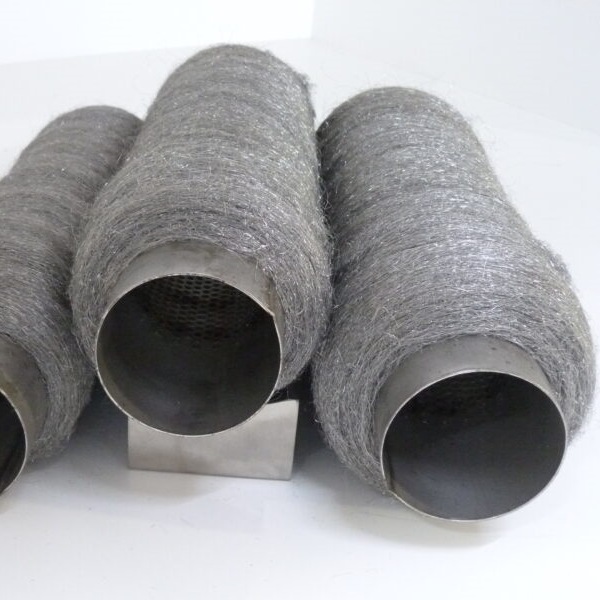
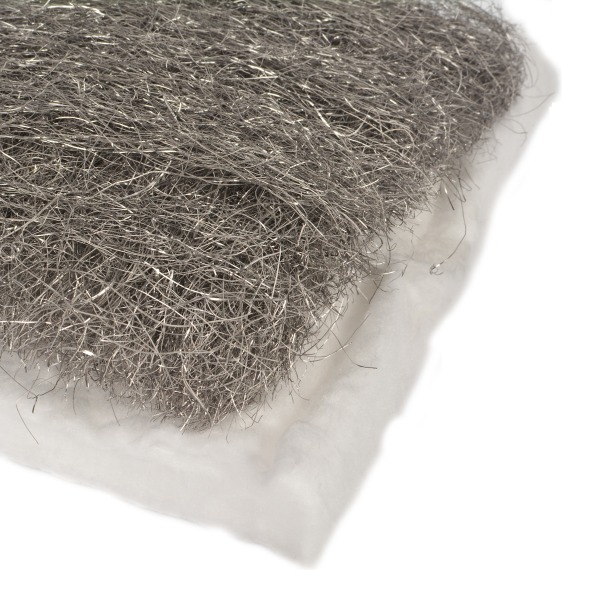
La laine d'acier inoxydable remplit une fonction quelque peu différente.
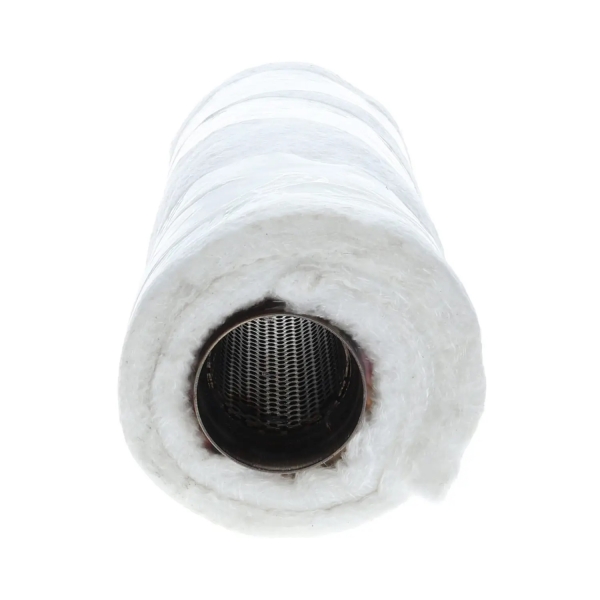
Il peut être utilisé comme matériau de garnissage, mais dans de nombreux systèmes d'échappement haute performance, il est installé directement autour du tube perforé comme couche protectrice.
La configuration typique devient :
Noyau perforé → laine d'acier inoxydable → garniture en fibre de verre → enveloppe du silencieux
La couche en acier inoxydable contribue à protéger les fibres acoustiques plus souples contre :
gaz d'échappement très chauds,
impulsions à haute vitesse,
turbulence autour des perforations,
exposition à la flamme,
et le soufflage progressif des fibres.
Cette conception est particulièrement utile pour les systèmes d'échappement exigeants des motos, de course, turbocompressés et à haut rendement.
C’est pourquoi comparer la laine de verre et la laine d’acier inoxydable comme s’il n’existait qu’un seul matériau est parfois trompeur. Dans de nombreux silencieux, elles remplissent des fonctions complémentaires.
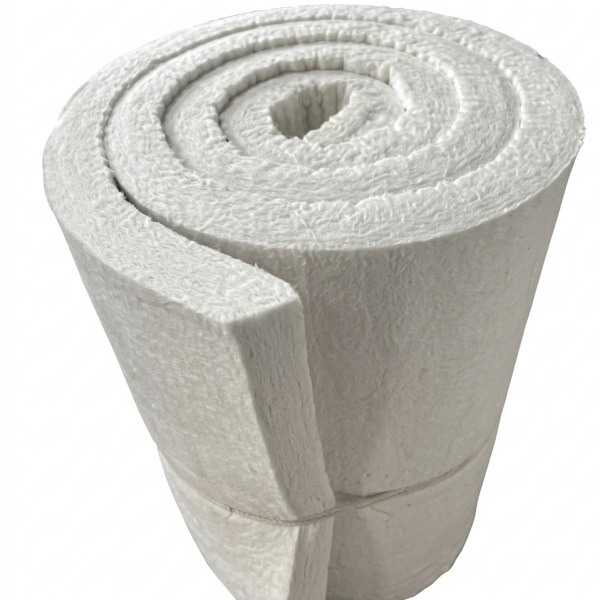
Lorsque les températures des gaz d'échappement sont particulièrement élevées, la fibre céramique peut être envisagée.
Le garnissage des silencieux en fibres céramiques est intéressant en raison de sa capacité à résister aux hautes températures et de sa conductivité thermique relativement faible.
Les applications possibles incluent :
high-temperature industrial silencers,
heavy-duty engine exhaust systems,
certain generator exhaust assemblies,
thermal-intensive exhaust equipment,
and special mufflers operating beyond the practical range of conventional glass fiber.
However, the highest temperature material is not automatically the best acoustic material.
Density, fiber diameter, resilience, vibration resistance, handling requirements, and long-term fiber stability must also be evaluated.
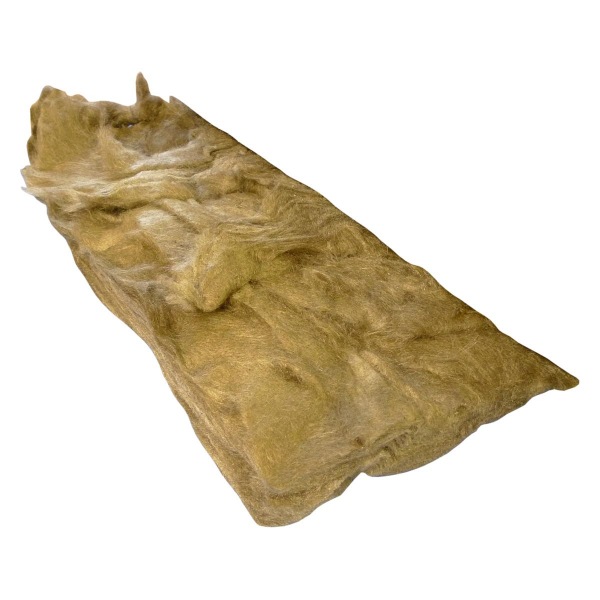
Basalt fiber provides another option between conventional glass fiber and more specialized high-temperature materials.
Produced from volcanic basalt rock, continuous basalt fibers can provide:
good thermal resistance,
mechanical stability,
chemical resistance,
vibration resistance,
and useful acoustic performance.
Basalt muffler packing can therefore be considered for automotive, motorcycle, heavy-duty, or industrial exhaust systems where designers want a mineral-fiber solution with elevated thermal capability.
| Packing Material | Primary Strength | Typical Position | Suitable Applications |
|---|---|---|---|
| Fiberglass | Efficient acoustic absorption | Main packing layer | Motorcycle, automotive, performance exhaust |
| Stainless Steel Wool | Heat and erosion protection | Around perforated core or as metallic packing | Racing, turbo, high gas velocity exhaust |
| Ceramic Fiber | Extreme-temperature capability | Main or supplementary insulation layer | Industrial and severe-temperature silencers |
| Basalt Fiber | Thermal and mechanical durability | Main acoustic packing layer | Heavy-duty, automotive and industrial exhaust |
The correct construction may combine two or more materials rather than using a single fiber throughout the silencer.
Two mufflers using exactly the same fiber can perform differently simply because the material was installed at different densities.
This is one of the most overlooked aspects of exhaust muffler packing.
If the fiber mass is insufficient, several problems can develop:
reduced acoustic absorption,
rapid fiber movement,
localized empty areas,
increased exhaust noise,
accelerated blowout.
The fibers may also redistribute under vibration and exhaust pulsation.
Over-compression creates another set of problems.
When fibrous material is compressed excessively, the void structure needed for acoustic energy dissipation changes.
The result can be:
poorer sound absorption in certain frequency ranges,
increased silencer weight,
difficult assembly,
reduced fiber resilience,
and unnecessary material consumption.
The goal is therefore not to put the maximum possible amount of packing inside the muffler.
The objective is to achieve a controlled and repeatable packing density suitable for the muffler geometry and target acoustic performance.
Muffler packing works in one of the harshest environments on a vehicle.
The material may experience thousands of heating and cooling cycles together with vibration and rapidly fluctuating exhaust pressure.
Several deterioration mechanisms can occur.
High-velocity exhaust gases passing through perforations gradually attack exposed fibers.
This is often called fiber blowout.
Continuous exposure to elevated temperature can reduce fiber resilience and alter the packing structure.
Vibration can cause loose packing to migrate or compact.
The silencer may develop areas with insufficient material even when the total amount of packing originally installed was correct.
Condensation, oil residue, incomplete combustion products, and other deposits can affect the condition of the acoustic fibers.
A theoretically suitable material may still fail prematurely if it is packed unevenly or installed at the wrong density.
Muffler packing deterioration is not always visible from outside the silencer.
Several operating changes can indicate that the material should be inspected.
Common signs include:
A noticeable increase in exhaust volume
The muffler gradually becomes louder because the effective acoustic mass has decreased.
A sharper or metallic exhaust note
When the packing layer becomes thin, sound energy interacts more directly with the metal shell.
Fibers coming from the tailpipe
Visible strands or particles at the outlet may indicate packing migration or blowout.
Hot spots on the muffler casing
Loss or movement of the internal packing can create uneven thermal distribution.
Rattling or internal movement
This can indicate loose material or deterioration of internal components.
Motorcycle silencers place especially high demands on packing material because the available volume is limited while exhaust temperatures and pulse velocity can be high.
For this reason, motorcycle exhaust packing normally needs to combine:
strong acoustic absorption,
low weight,
good thermal stability,
resistance to vibration,
easy repacking,
and controlled fiber retention.
Both two-stroke and four-stroke engines use packed silencers, but their operating environments differ considerably.
Two-stroke exhaust packing can be affected heavily by oil, combustion residue, and frequent repacking cycles.
Four-stroke performance exhausts may expose the material to higher sustained temperatures and aggressive exhaust pulses.
Selecting packing purely by motorcycle type is therefore insufficient. Muffler construction and engine operating conditions should also be considered.
Performance exhaust manufacturers often need to reduce sound without introducing excessive backpressure.
Straight-through absorption mufflers are useful in this situation because the exhaust path remains relatively open.
The acoustic packing surrounding the perforated core becomes a critical component.
Depending on the application, manufacturers may specify:
continuous fiberglass packing,
stainless steel wool core protection,
composite stainless/fiberglass systems,
basalt fiber,
or specialized high-temperature fibers.
For racing exhaust systems, packing retention becomes particularly important because high gas velocities can rapidly damage exposed loose fibers.
Industrial silencers operate under a different set of requirements.
Applications can include:
diesel generators,
gas engines,
compressors,
turbines,
exhaust treatment equipment,
heavy machinery,
power generation systems,
and industrial ventilation or acoustic control systems.
In these installations, designers may prioritize:
continuous operating temperature,
acoustic absorption over a specified frequency range,
long maintenance intervals,
fiber stability,
corrosion resistance,
and repeatable packing density.
Industrial buyers therefore often purchase muffler packing by engineering specification rather than simply selecting a consumer repacking kit.
Manufacturers normally have several ways to introduce fiber into a silencer.
Loose fibers or strands allow considerable flexibility during assembly.
They work well where the muffler geometry varies or packing is performed manually.
The challenge is maintaining consistent density from one muffler to another.
Mats provide more predictable thickness and make material handling easier during production.
They are especially suitable when the silencer has a regular cylindrical geometry.
A measured amount of fiber is enclosed inside a lightweight retaining fabric or mesh.
This allows manufacturers to control fiber mass before installation.
A tubular packing assembly can be fitted around the perforated core, reducing installation time and helping maintain circumferential coverage.
BSTFLEX develops customized packing formats including fiberglass-based assemblies for OEM exhaust production.
A purchase specification should contain more information than simply:
“Fiberglass muffler packing.”
For repeatable production, buyers should consider supplying:
| Specification Item | Why It Matters |
|---|---|
| Fiber material | Determines thermal and mechanical behavior |
| Silencer internal diameter | Defines available packing space |
| Perforated core diameter | Determines required packing thickness |
| Muffler length | Determines fiber quantity |
| Target packing density | Influences acoustic performance |
| Continuous exhaust temperature | Determines material suitability |
| Peak temperature | Identifies short-duration thermal exposure |
| Engine type | Helps evaluate exhaust environment |
| Packing format | Loose fiber, mat, pillow, sock or custom assembly |
| Annual quantity | Determines manufacturing and packaging method |
When these parameters are available, the packing can be engineered around the silencer rather than supplied as a generic bulk fiber.
Manual loose packing creates several variables.
One operator may install more material than another. Distribution around the perforated tube may also vary.
Preformed systems reduce this variability.
A packing sock, bag, pillow, or measured mat can provide:
defined material weight,
more uniform circumferential distribution,
reduced fiber handling,
shorter assembly time,
cleaner production,
improved batch repeatability.
For medium- and high-volume exhaust manufacturing, those manufacturing benefits can be as important as the thermal properties of the fiber itself.
A practical starting point is to identify the dominant failure risk.
Consider fiberglass as the primary acoustic layer.
Consider a stainless steel wool or metallic mesh protection layer before the main fiber packing.
Evaluate ceramic or other elevated-temperature fibers.
Consider materials and packing forms with stronger dimensional stability and controlled retention.
Consider preformed socks, pillows, mats, or custom packing assemblies rather than uncontrolled loose fill.
BSTFLEX manufactures high-temperature thermal and acoustic materials for exhaust systems and can support both replacement packing and OEM silencer production.
Available development options can include:
fiberglass muffler packing,
glass fiber silencer packing,
stainless steel wool packing,
ceramic fiber packing,
basalt-based packing,
loose fiber,
mats,
rolls,
packing bags,
packing pillows,
tubular packing socks,
and customized preformed assemblies.
Sizes, packing weight, fiber combination, retaining construction, and packaging can be developed according to customer drawings, samples, or silencer dimensions.
For applications requiring easier assembly and improved fiber containment, see theFiberglass Muffler Packing Sock with Woven Glass Mesh Bag.
For additional material options, visit theBSTFLEX Muffler Packing category.
There is no universal best material. Fiberglass is widely used because of its acoustic efficiency and weight, stainless steel wool is effective for protecting packing near the perforated core, while ceramic and basalt fibers may be selected where higher temperature capability is required.
Yes. Fiberglass is one of the most common acoustic materials used in absorption-type exhaust silencers because its fibrous structure provides efficient sound absorption while remaining relatively lightweight.
It can be used alone in some designs, but stainless steel wool and fiberglass often perform different functions. Stainless steel wool can protect the inner packing from exhaust erosion, while fiberglass provides the principal acoustic absorption layer.
Packing can escape because of fiber erosion, excessive gas velocity, damaged retaining mesh, incorrect packing density, thermal degradation, or deterioration around the perforated core.
Not necessarily. Excessive compression can reduce the open fiber structure needed for effective acoustic absorption. Packing density should be controlled rather than maximized.
There is no fixed interval for every exhaust system. Replacement frequency depends on exhaust temperature, engine type, riding conditions, packing material, gas velocity, silencer design, and operating hours.
Oui. Un emballage OEM peut être fourni en fonction du diamètre du noyau, du diamètre de l'enveloppe, de la longueur du silencieux, du poids d'emballage cible, des spécifications du matériau, des exigences de température et du format d'installation préféré.
Lors de la conception d'un système d'échappement, la partie visible du silencieux attire souvent toute l'attention, mais le matériau caché entre cette partie et le noyau perforé détermine une part importante du comportement acoustique du silencieux.
Un ingénieur correctement conçumatériau d'emballage du silencieuxne devrait pas simplement survivre à la chaleur.
Il est indispensable de maintenir un rapport optimal entre la structure des fibres, leur densité, leur absorption acoustique, leur résistance à l'érosion et la régularité de leur installation.
Pour les silencieux standard de motos et d'automobiles, la fibre de verre demeure l'un des matériaux les plus polyvalents. Dans les environnements d'échappement exigeants, la laine d'acier inoxydable, la fibre céramique, la fibre de basalte ou des combinaisons multicouches peuvent prolonger leur durée de vie.
Pour les fabricants d'échappements d'origine, la prochaine étape ne consiste pas simplement à choisir une fibre.
Il s'agit de définir le correctsystème de garnissage du silencieux d'échappementpour la géométrie du silencieux, la température des gaz d'échappement, l'objectif acoustique et la méthode de production.
BSTFLEX peut fabriquer et personnaliser des matériaux d'isolation pour silencieux destinés aux systèmes d'échappement de motos, d'automobiles, de courses, de générateurs, de bateaux et industriels.
Contactez BSTFLEX en précisant les dimensions de votre silencieux, sa température de fonctionnement, le format de garnissage requis et la quantité annuelle pour la sélection des matériaux et le développement d'échantillons.

No.10, Chuangxin North Road, Nanshan Park, Ningguo Economic and Technological Development Zone, Ningguo City, Anhui Province, China
tél/Whatsapp : 0086-15856303740
e-mail : sales@bstbraidedsleeve.com
Skype : vanesa-cheng